For the best experience, click the gear icon in the player and select 1080p.
There is a moment every new design director eventually hits. The work hasn’t changed, but everything else has. You’re no longer just a designer. You’re responsible for the output, the growth, and the cohesion of an entire team — and nobody gave you a manual for that.
Most directors figure it out by trial and error. They work harder, stay later, and become the bottleneck in every decision that matters. It’s not a sustainable model. And right now, there’s a better one.
This post is a companion to my new training video, Design Leadership at Scale, where I walk through how to build AI-powered operational systems that move your entire organization forward — not just your design team. If you’re a new design director, a VP of design, or a creative executive trying to get more from your team without burning them out, this is for you.
The Identity Shift Nobody Talks About
The biggest challenge for a new design director isn’t learning a new tool or managing a larger budget. It’s the identity shift.
You go from making things to managing the people who make things. Your judgment is still essential — but now it has to scale across multiple designers, multiple workstreams, and multiple stakeholders who all have competing priorities and different definitions of “done.”
The directors who navigate this well aren’t the ones who work the hardest. They’re the ones who build the best systems. Systems that create clarity, reduce friction, and give their teams the conditions to do their best work.
AI is the most powerful accelerant for that kind of systems thinking that has ever existed in our industry. And the directors who recognize that early will lead the most effective, most respected, and most impactful design organizations.
What Organizational Leverage Actually Means
Organizational leverage means building systems that do more than you can do alone.
That’s it. It’s not a complex concept. But the execution requires intentionality — and that’s where most new directors fall short. They default to managing tasks instead of designing infrastructure. They put out fires instead of building the systems that prevent them.
Think about what that looks like in practice with AI.
It can synthesize 20 user interviews into themes in minutes, so your researchers are focused on insight, not transcripts. It catches inconsistencies in your design system before engineering ever sees them, which builds real trust across the org. And in sprint planning, capacity risks and scope gaps surface before the first phase even begins.
That’s the compounding effect. The whole team moves faster, decisions get cleaner, and you stay focused on your people and the direction of the organization. That is what leverage actually feels like.
Streamlining recurring tasks and building automated systems into your workflow buys you something you cannot get any other way: clarity. And when things are clear, friction drops. Your team stops spinning and starts moving. AI handles the invisible work that quietly drains everyone’s time, so you and your team can stay focused on what actually matters.
Where AI Fits Into Your Design Organization
The key is not to build a separate AI process on top of everything else. The better move is to look at your existing workflow and ask: where can this reduce friction and improve clarity?
Start by asking these questions about your team:
- Where do we have recurring friction?
- Where are people manually summarizing information?
- Where is there already repetition in the work?
- Where are teams spending time translating information instead of acting on it?
Those are your entry points. Your job is to build systems that make that leverage consistent, equitable, and sustainable — across your entire organization.
Here is how AI fits into each discipline on a product design team:
UI Designers benefit from AI that audits component libraries for inconsistencies, generates design token documentation, and flags accessibility issues before anything reaches a review. Less back-and-forth, cleaner handoffs, and more trust between design and engineering.
UX Researchers benefit when AI handles the heavy synthesis work — thematic clustering from interviews, pattern recognition across sessions, and draft screener questions or discussion guides. Your researchers stay in the insight business, not the admin business.
Content Designers gain a strong thought partner for tone consistency, copy variations, and content audits across a product. AI can check voice and flag anywhere the language is drifting from the brand standard — quietly and consistently.
Engineering and Development teams benefit most when AI makes their job easier, not smaller. Engineers tend to self-optimize once they see what AI can do on the technical side. Get them started and give them the runway. The results can surprise you.
Getting Started with AI in Design Teams
This is the section most leaders skip to first — and for good reason. Implementation is where the theory either works or it doesn’t. Here is a practical, tested starting point.
Start with two or three recurring workflows before you try to roll out AI across everything. It’s the fastest way to show your team the value — and the easiest way to avoid the resistance that naturally comes with changing how people work.
1. Build a Weekly Sprint Summary Template
Give your team a standard format for dailies and retrospectives. Everyone reports progress the same way, every meeting. No chasing, no inconsistency, no missed details. Have the team run their summary through AI for clarity and structure before it goes out. It’s a small habit that quietly upgrades the quality of everything your team communicates upward.
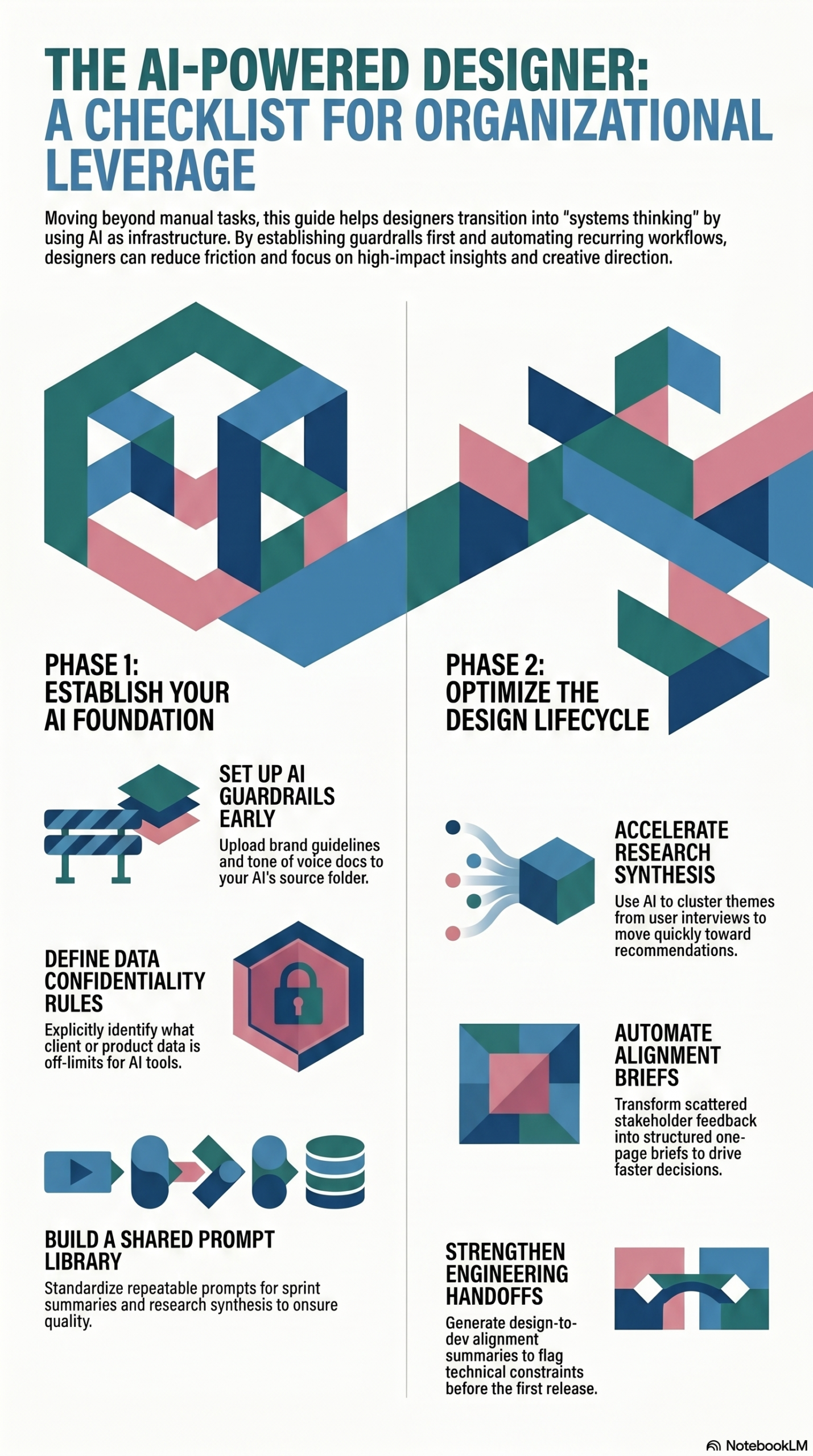
2. Use AI to Accelerate Research Analysis
AI can pull themes out of research sessions fast. Use it. Get your team solving UX problems early instead of still processing data after the sprint has already moved on. The shift from “we’re still synthesizing” to “here’s what we found and here’s what we recommend” is significant — both for team morale and for organizational trust.
3. Create Design-to-Engineering Alignment Briefs
Before any UI handoff, create a design alignment summary that includes specs. Dev teams can review where the design is heading, flag potential issues early, and make the handoff — and the next release — go as smoothly as possible. This single habit reduces rework, reduces tension, and builds credibility for your design team across the org.
4. Synthesize Your 1:1 Coaching Notes
After your one-on-ones, feed your notes into AI and let it surface patterns, themes, and skill development opportunities you can bring back to your direct reports. It turns scattered notes into a real coaching practice — and it makes you a more consistent, more structured leader without requiring hours of additional effort.
5. Turn Stakeholder Feedback Into One-Page Briefs
After a leadership meeting, take all the scattered comments and turn them into a single brief: goals, constraints, decisions, tradeoffs, open questions. Send it to everyone in the room. Watch how much faster and more decisively your organization starts to move. This practice alone has more impact on organizational alignment than most quarterly planning exercises.
6. Set Up Your AI Guardrails Early
Create a regularly updated source document and share it with your team. It should contain your brand guidelines, tone of voice, frequently used messaging, visual identity standards, and anything else your organization has aligned on. Have everyone upload it into the sources folder of whatever AI tool your team is using. This is how you make sure everyone — across design, content, engineering, and product — is working from the same source of truth.
7. Establish an Approved Tools List and Prompt Library
Not all AI tools are appropriate for all tasks, and not all prompts are created equal. Build a short approved tools list that your team can reference. Pair it with a prompt library of tested, repeatable prompts for your most common workflows — sprint summaries, research synthesis, stakeholder briefs, and design reviews. This reduces the learning curve for new team members and ensures consistent output quality across the team.
8. Define Confidentiality Rules Before You Need Them
Be explicit about what information can and cannot go into an AI tool. Client data, unreleased product details, personnel information — these need clear guardrails. Set the rules before something goes wrong, not after. A one-page AI usage policy shared with your team takes less than an hour to write and protects the organization indefinitely.
The Operational Foundation That Changes Everything
Recurring tasks are the fastest win — but they’re just the starting point.
The real goal is building predictable processes everywhere you can. Predictable processes give your team stability. They also have a way of putting out fires before anyone even smells smoke. Once you see what’s possible in one area, the instinct to apply it broadly becomes natural.
The directors who do this well share a few things in common. They plan ahead. They build with consistency in mind. They think about systems before they think about outcomes. And they use AI not as a shortcut, but as infrastructure — the kind that keeps working even when they step away from the room.
AI doesn’t replace your judgment. It validates it. When your systems are working, your team stops waiting and starts moving. The friction drops, the clarity rises, and the work gets better — across the entire organization.
A Final Thought for New Design Directors
You became a design director because you see things others don’t. You understand how design decisions ripple across products, teams, and user experiences in ways that most people in the room can’t fully articulate.
Now build the infrastructure that lets your whole organization see it too.
Start small, stay consistent, and watch what your team becomes.
Watch the full training video above for a complete walkthrough of the frameworks, workflows, and AI implementation strategies covered in this post. If this resonated with you, follow along on LinkedIn for more frameworks, tools, and honest lessons from 20 years of building design teams at every level.